

AI tools have moved from science fiction into everyday school life faster than almost anyone expected. A few years ago, “AI in the classroom” meant a computer lab session once a week. Today, students open chatbots the same way they open a search engine, and teachers are rethinking assignments they’ve used for decades.
This shift brings real opportunities — faster feedback, personalized explanations, better study habits — but it also raises a serious question: where is the line between using AI to learn and using AI to avoid learning? Understanding ethical AI use in education isn’t just about following rules. It’s about protecting your own growth as a thinker, writer, and problem-solver.
This guide breaks down what ethical AI use actually looks like for students, parents, and educators, with practical examples you can apply right away.
What Does Ethical AI Use in Education Mean?
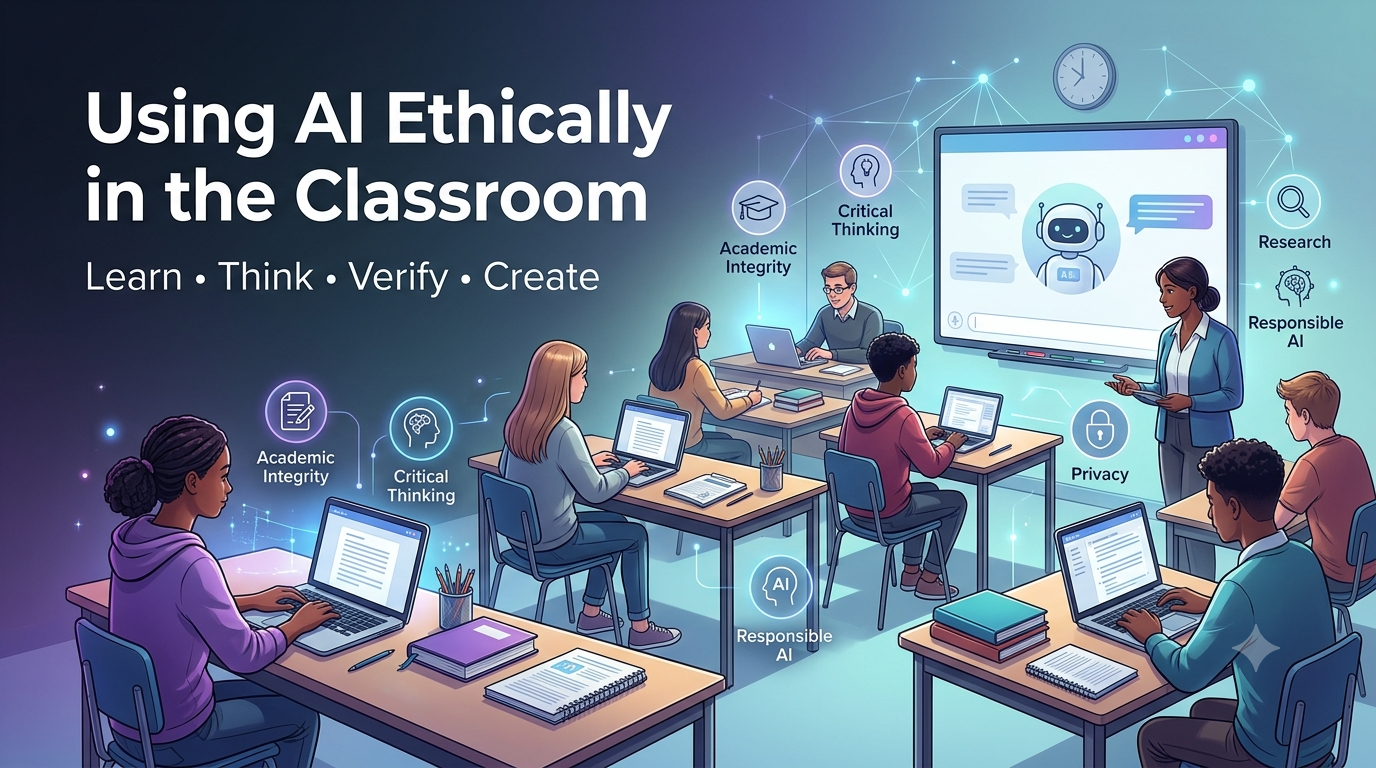
At its core, ethical AI use in education comes down to five ideas: honesty, transparency, learning, responsibility, and privacy.
- Honesty means not pretending AI-generated work is entirely your own.
- Transparency means being open about when and how you used AI, especially if a teacher asks.
- Learning means using AI to build understanding, not to skip the thinking process.
- Responsibility means you’re still accountable for everything you submit, even if AI helped shape it.
- Privacy means protecting your own data and other people’s information when interacting with AI tools.
Ethical use isn’t about avoiding AI altogether. It’s about using it the way you’d use a tutor, a study group, or a reference book — as support for your own effort, not a replacement for it.
Why Are Schools and Colleges Using AI Tools?
AI adoption in classrooms isn’t just a trend — it reflects genuine educational benefits when used thoughtfully:
- Brainstorming — generating starting points for essays, projects, or research questions
- Personalized learning — adapting explanations to a student’s pace or learning style
- Explaining difficult concepts — breaking down complex topics in simpler language
- Language assistance — helping non-native speakers understand or express ideas
- Study planning — organizing revision schedules around exams and deadlines
- Feedback and revision — offering a second perspective on drafts before submission
- Accessibility — supporting students with different learning needs through text-to-speech, simplified explanations, or reading assistance
Used this way, AI in high school classrooms and AI in college classrooms functions less like a shortcut and more like an on-demand study companion.
10 Ethical Ways Students Can Use AI
- Brainstorming ideas — A student stuck on an essay topic asks AI for five possible angles, then picks and develops one independently.
- Understanding difficult concepts — A biology student asks AI to explain the Krebs cycle in simpler terms before returning to the textbook.
- Creating study plans — A student preparing for finals asks AI to help organize a two-week revision schedule.
- Generating practice questions — A student studying for a history exam asks AI to create sample quiz questions to self-test.
- Getting feedback on writing — A student shares a finished draft and asks where the argument feels weak, then revises it themselves.
- Improving grammar and clarity — A student uses AI to spot awkward sentences, then rewrites them in their own voice.
- Learning new subjects — A student exploring coding for the first time uses AI to explain basic programming logic.
- Creating revision notes — A student summarizes a long chapter with AI assistance, then reviews and edits the summary for accuracy.
- Practicing presentations — A student rehearses a speech and asks AI for feedback on pacing or clarity.
- Exploring different perspectives — A student researching a debate topic asks AI to outline counterarguments they hadn’t considered.
In each case, AI supports the thinking — it doesn’t replace it.
How AI Can Become Unethical in the Classroom
The line gets crossed when AI output replaces a student’s own work or understanding. Common examples include:
- Submitting AI-generated assignments as original work
- Using AI during exams when it’s explicitly prohibited
- Copying AI answers without understanding the material
- Fabricating sources or references suggested by AI
- Creating fake research data
- Using AI to bypass required learning steps, like skipping a math process and only submitting the final answer
- Presenting AI-generated work as entirely personal effort without disclosure
These actions undermine the purpose of the assignment — and ultimately hurt the student more than anyone else, since the skills never actually get built.
AI and Academic Integrity
Academic integrity rests on a few core ideas: plagiarism, originality, authorship, citation, and disclosure.
Submitting AI-written text as your own work is a form of plagiarism, even though no human author is being copied. Originality means the ideas and expression are genuinely yours. Authorship means you can explain and defend what you submitted. Citation means giving credit where it’s due — some institutions now expect students to cite AI tools the way they’d cite a source. Disclosure means telling your teacher when and how you used AI, if required.
Importantly, students remain fully responsible for anything they submit — including factual errors, poor arguments, or plagiarized content that AI may have generated. “The AI got it wrong” is not an excuse a teacher or professor will accept.
How Teachers Can Encourage Ethical AI Use
Educators play a major role in shaping how students engage with AI. Practical strategies include:
- Creating clear AI-use policies for each course or assignment, since rules can vary by class
- Teaching AI literacy — helping students understand what AI can and can’t do well
- Designing assignments that encourage original thinking, such as personal reflection or in-class writing
- Asking students to explain their reasoning, verbally or in writing, to confirm understanding
- Using AI for feedback rather than replacing student work, such as having students revise based on AI suggestions
- Discussing AI limitations and misinformation openly, so students learn healthy skepticism
Privacy and Data Safety When Using AI Tools
Students and teachers should avoid entering sensitive information into AI tools, including:
- Personal information (full names, addresses, ID numbers)
- Private student records or grades
- Passwords or login credentials
- Confidential school documents
- Sensitive research data, especially in academic studies involving real participants
Many AI tools store or process conversation data in ways users don’t fully understand. Before relying on any tool regularly, it’s worth reading its privacy policy and terms of use — or asking a teacher or IT department if the tool is approved for school use.
How to Check AI-Generated Information
AI tools can sound confident while being factually wrong. This is sometimes called “hallucination,” and it’s one of the most important limitations to understand. A simple verification process:
- Check the original source the AI claims to reference.
- Compare information with a reliable, independent source.
- Verify statistics and quotations before including them in any assignment.
- Check references to confirm they actually exist and say what AI claims.
- Ask a teacher or subject expert when something seems uncertain or important.
A Simple Ethical AI Framework for Students
A short mental checklist can make ethical decisions easier in the moment:
ASK → CHECK → CREATE → DISCLOSE → LEARN
- ASK: What am I actually using AI for right now?
- CHECK: Is AI allowed for this specific task or assignment?
- CREATE: Am I still doing my own thinking and producing my own work?
- DISCLOSE: Do I need to mention AI assistance to my teacher?
- LEARN: Did using AI actually help me understand the topic better?
If the answer to “LEARN” is no, that’s usually a sign AI was used as a shortcut rather than a study tool
Examples of Ethical vs Unethical AI Use
| Situation | Ethical Use | Unethical Use |
|---|---|---|
| Homework | Asking AI to explain a confusing math concept, then solving problems independently | Asking AI to solve and submit the homework answers |
| Essay writing | Using AI to brainstorm ideas or get feedback on a draft you wrote | Having AI write the essay and submitting it as your own |
| Research | Using AI to understand a topic before searching verified academic sources | Using AI-invented facts or fake citations in a research paper |
| Presentations | Practicing delivery and getting feedback on clarity from AI | Having AI write your entire speech word-for-word to read aloud |
| Studying | Using AI to generate practice quiz questions | Using AI during a closed-book exam when it’s not allowed |
| Exams | Reviewing AI-explained concepts beforehand to prepare | Using AI in real time during a prohibited exam |
The Future of AI in Education
AI tools are likely to become a standard part of classrooms, much like calculators and search engines before them. But as this happens, human judgment, creativity, critical thinking, communication, and subject knowledge will matter more — not less. AI can generate a first draft or explain a concept, but it can’t replace the process of genuinely wrestling with an idea, forming an opinion, and defending it.
The students who benefit most from AI in the coming years will likely be the ones who use it to sharpen their thinking, not outsource it.
Conclusion
Ethical AI use in education isn’t about avoiding a powerful tool — it’s about using it in a way that actually helps you learn. AI can be a brainstorming partner, a study assistant, and a source of feedback, but it can’t replace the understanding you build through your own effort. Before using AI for any school task, take a moment to ask whether it’s allowed, whether you’re still doing the thinking, and whether it’s genuinely helping you learn. Because in the end, the goal of education was never just to produce finished assignments — it was always to build the skills and knowledge that stay with you long after the assignment is turned in.
FAQs
1. Is it cheating to use AI for homework? Not necessarily. Using AI to understand a concept or brainstorm ideas is generally acceptable, but submitting AI-generated answers as your own original work is considered academic dishonesty. Always check your teacher’s specific policy.
2. Can teachers detect AI-generated writing? Detection tools exist, but they aren’t fully reliable and can produce false positives. The safer approach is always using AI transparently and within your institution’s guidelines, rather than relying on avoiding detection.
3. Do I need to tell my teacher if I used AI? This depends on your school or professor’s policy. Many institutions now require disclosure when AI assistance is used. When in doubt, ask directly or check the syllabus.
4. Can AI tools give wrong information? Yes. AI can generate incorrect facts, fake citations, or outdated information confidently. Always verify important details using reliable, independent sources.
5. Are AI tools safe to use with personal information? Not always. Avoid entering personal data, private records, or confidential documents into AI tools unless you understand and trust the platform’s privacy policy.