


5 Science-Backed Techniques That Work Meta Description: Learn how to improve memory using proven methods like spaced repetition and active recall. Backed by neuroscience — simple habits that help you remember more.
How to Improve Memory: 5 Science-Backed Techniques That Actually Work
Have you ever walked into a room and forgotten why you went in there? Or crammed all night for an exam, only to draw a blank a week later? If you’ve ever wondered how to improve memory in a way that actually lasts, the answer isn’t “try harder” — it’s understanding how your brain stores and retrieves information in the first place.In this guide, we’ll break down the neuroscience of memory and share five practical, research-backed techniques for how to improve memory retention, whether you’re studying for an exam, learning a new language, or just trying to remember more of daily life.
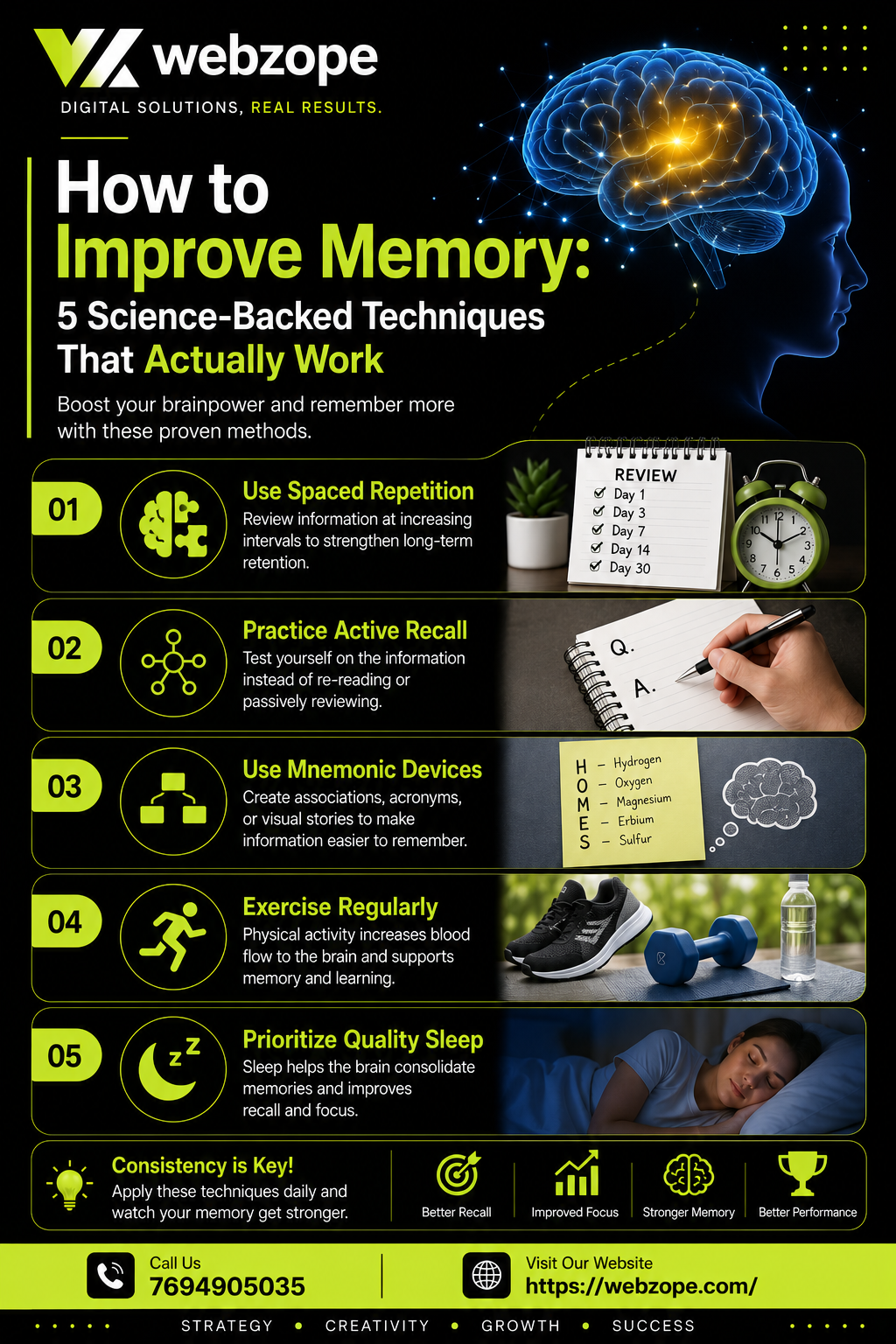
How Memory Actually Works
Neuroscientists generally divide memory into three stages:
Encoding – turning information into a form your brain can store
Storage – holding onto that information over time
Retrieval – pulling it back up when you need it
Most “bad memory” isn’t actually a storage problem — it’s a retrieval problem. The information is often still there; you just haven’t built a strong enough path back to it. That’s exactly why the techniques below work: they’re designed to strengthen retrieval, not just cram in more information.

The Forgetting Curve: Why You Forget So Fast
In the 1880s, psychologist Hermann Ebbinghaus ran a series of experiments on himself, memorizing nonsense syllables and tracking how much he forgot over time. He found something strikingly consistent: without reinforcement, we lose the majority of new information within the first 24 hours, and the loss continues — though more slowly — over the following days.This is known as the forgetting curve, and it’s the single biggest reason cramming feels productive but rarely sticks. Information you learn once fades fast unless something intervenes — which brings us to the first (and most powerful) technique for how to improve memory.
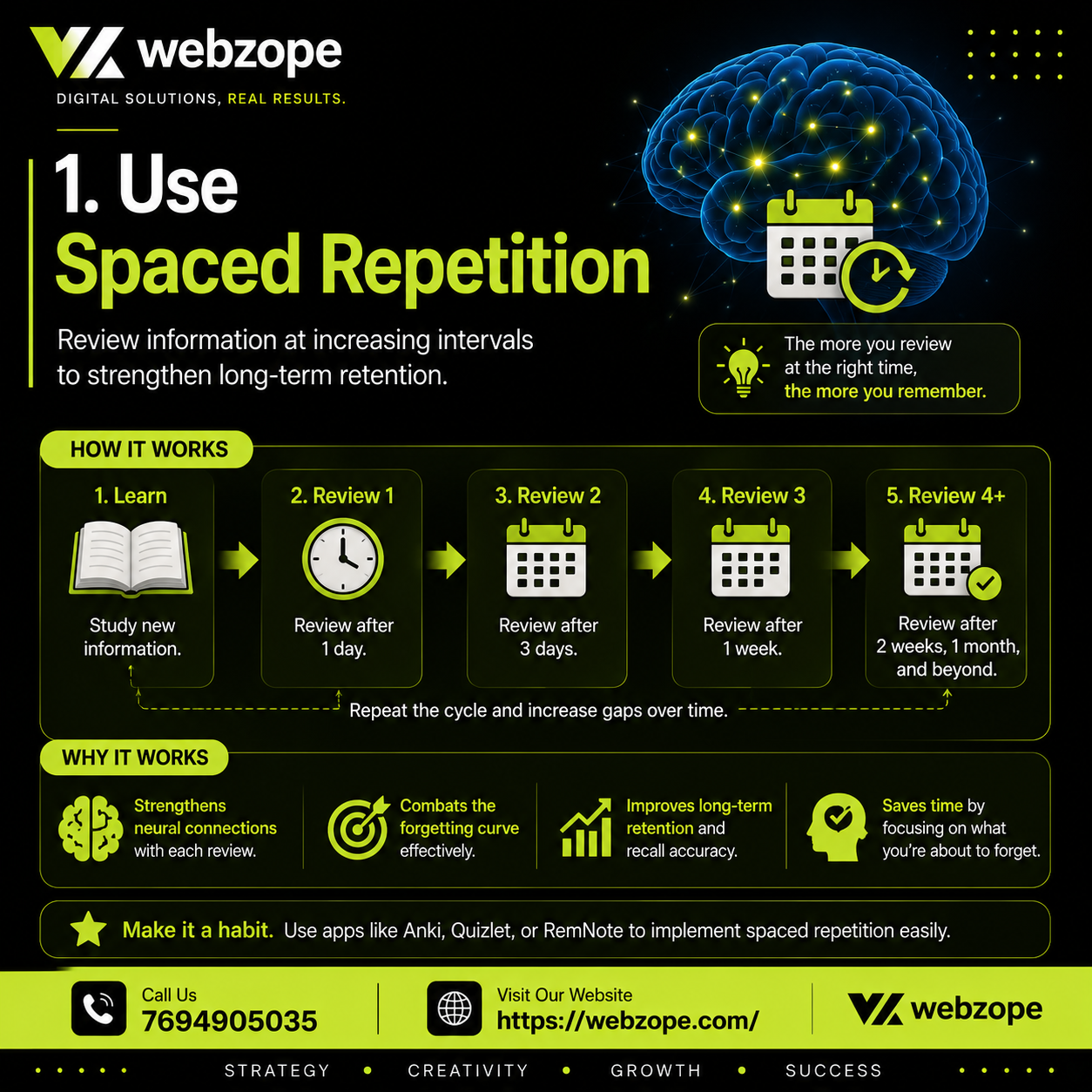
1. Use Spaced Repetition
Each time you revisit information right before you’re about to forget it, the forgetting curve resets and flattens. This is the principle behind spaced repetition: reviewing material at increasing intervals (a day later, then a few days later, then a week later, and so on).Instead of studying a topic for three hours the night before a test, you’ll get far better results studying it for 20 minutes a day over two weeks. Apps like Anki and Quizlet build entire study systems around spaced repetition, but you don’t need an app — a simple habit of revisiting notes on a schedule works just as well.
2. Practice Active Recall
Rereading your notes feels like learning, but it’s mostly passive — your brain recognizes the material without actually retrieving it, which is a much weaker mental workout.Active recall flips this. Instead of looking at the answer, you try to produce it from memory first — through flashcards, practice questions, or simply explaining a concept out loud without your notes. This retrieval effort is what actually strengthens the neural pathway. Studies consistently show that students who test themselves outperform students who just reread material, even when the re-readers spend more total time studying

3. Prioritize Sleep
Memory isn’t just built while you’re awake. During sleep — particularly deep sleep and REM sleep — your brain replays and consolidates the day’s experiences, transferring information from short-term storage in the hippocampus to longer-term storage in the cortex. Pulling an all-nighter to study doesn’t just leave you tired; it undercuts the very consolidation process that would have made the studying worthwhile.

4. Connect New Information to What You Already Know
New information sticks better when it’s linked to existing knowledge. Try explaining a new concept using an analogy from something familiar, or asking yourself, “What does this remind me of?” This process, sometimes called elaborative encoding, gives your brain more “hooks” to retrieve the memory later.

5. Teach What You’ve Learned
Explaining a concept to someone else — or even to an empty room — forces active retrieval and immediately exposes gaps in your understanding. This is sometimes called the “protégé effect,” and it’s one of the fastest ways to find out what you actually know versus what just feels familiar.

Frequently Asked Questions
What is the fastest way to improve memory? The fastest evidence-based way to improve memory is active recall combined with spaced repetition: testing yourself on material at increasing intervals rather than passively rereading it.Does sleep really affect memory? Yes. Sleep, especially deep and REM sleep, is when your brain consolidates new memories, moving them from short-term to long-term storage.Can diet or exercise improve memory? Regular physical exercise and a balanced diet support overall brain health, but the techniques with the strongest direct evidence for memory improvement are spaced repetition and active recall.
The Takeaway
If you want to know how to improve memory, the answer isn’t about working harder — it’s about working with your brain’s natural rhythms. Space out your review sessions, test yourself instead of rereading, protect your sleep, and connect new ideas to what you already know. Do that consistently, and you’ll remember more with far less effort than any all-night cram session could ever produce.