


Let me be honest with you.
The NEP 2026 India education policy is no longer just a government document — it’s showing up in real classrooms, real textbooks, and real exam halls across the country.
When the National Education Policy 2020 was first announced, most people dismissed it as another 400-page PDF collecting digital dust. I covered education policy for years and even I was skeptical. But six years in, something is genuinely shifting. Not everywhere. Not perfectly. But the direction is unmistakable – and if you’re a student, parent, or teacher in India, you need to understand exactly what’s changing and why it matters to you right now.
Fast forward to 2026, and I have to admit – something is genuinely shifting inside India’s classrooms. Not everything, not everywhere, not perfectly. But the direction? It’s unmistakable.
If you’re a student wondering what’s changed, a parent trying to understand your child’s new report card, or a teacher navigating a brand-new curriculum framework, this is the one article you need to read today.
What Is NEP 2020 and Why Does It Matter in 2026?
The National Education Policy 2020 (NEP 2020) is India’s first complete education overhaul in 34 years — the last one was back in 1986, when most of today’s teachers hadn’t even finished school themselves. It was approved by the Union Cabinet on July 29, 2020, and it set out to completely reimagine how 260+ million Indian students learn, are assessed, and are prepared for the real world.
Now in 2026, six years since its launch, NEP is no longer just a policy on paper. It’s showing up in real classrooms, real textbooks, and real exam halls.
Here’s what’s changed and why it matters to you.
1. The Old 10+2 System Is Gone — Here’s What Replaced It
This is the change most parents are asking about right now, and rightfully so.
The familiar 10+2 school structure that generations of Indians grew up with has been replaced by a 5+3+3+4 framework. It sounds like a math problem but it’s actually a smarter way to think about how children learn.
- Foundational Stage (5 years): Pre-school + Grades 1–2, covering ages 3–8
- Preparatory Stage (3 years): Grades 3–5, ages 8–11
- Middle Stage (3 years): Grades 6–8, ages 11–14
- Secondary Stage (4 years): Grades 9–12, ages 14–18
The idea is simple: early childhood education finally gets the serious attention it deserves. Brain science tells us that over 85% of brain development happens before age 6, and the old system basically ignored the first three years of formal schooling entirely.
As of 2026, this structure is now implemented in 35% of schools across India — with more states rolling it out every quarter.
2. Rote Learning Is (Finally) Being Killed Off
I can’t tell you how many students I’ve spoken to over the years who could recite the definition of photosynthesis perfectly but had no idea what a plant actually needed to survive. That’s what rote-based education does — it produces students who can memorize but not think.
NEP 2026 is actively dismantling this.
Competency-based education is replacing memorization-heavy curricula in most major school boards. Students are now being assessed on whether they can apply knowledge — not just repeat it. CBSE, for example, has reformed its board exam design to reduce high-pressure, all-or-nothing testing. The policy even allows students to appear for board exams on two occasions in a school year — a huge stress reliever for millions of students.
PARAKH (Performance Assessment, Review, and Analysis of Knowledge for Holistic Development) has been established as a national body specifically to regulate and improve how students are assessed. That’s not just a name change — it represents a genuine philosophical shift in what Indian education thinks success looks like.
3. AI in Classrooms Isn’t Sci-Fi Anymore — It’s Tuesday
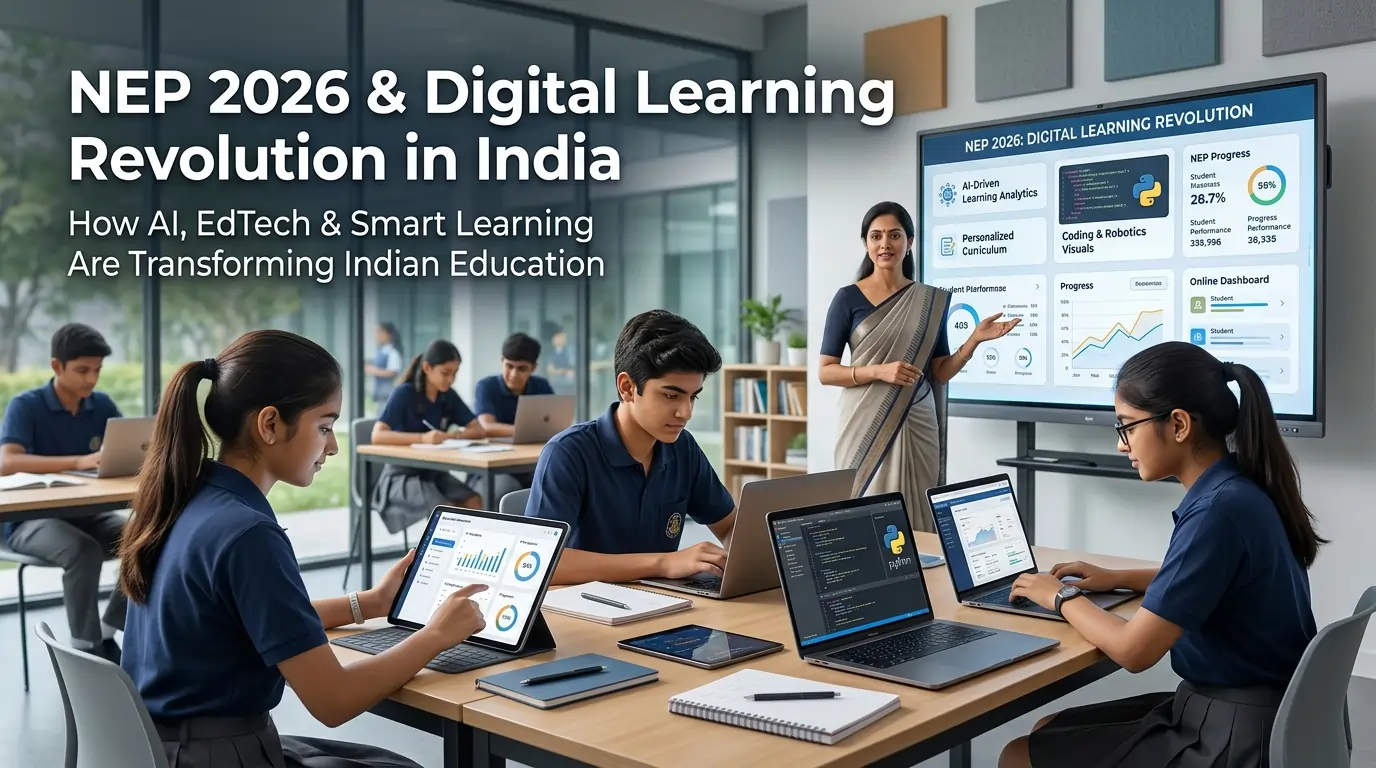
Here’s a stat that stopped me in my tracks: AI-powered personalized learning is now active in over 15,000 Indian schools. And 74% of examination boards have adopted automated evaluation systems.
We’re not talking about fancy screens and robot teachers. We’re talking about adaptive learning platforms that identify where a student is struggling and adjusts the difficulty accordingly — the kind of thing that used to require a private tutor.
EdTech has exploded in India, and NEP actively supports this through the National Educational Technology Forum (NETF), which guides how technology is integrated into teaching and learning. India’s education sector is now projected to reach $313 billion by 2030, with EdTech playing a major role in getting there.
Virtual reality labs have already landed in 2,500 institutions. Hybrid learning — a mix of in-person and online — is now the new normal for 82% of higher education institutions.
4. Foreign Universities Are Coming to India — And That Changes Everything
This one is big, and it doesn’t get enough coverage.
NEP 2020 explicitly invited quality foreign universities to set up campuses in India. In 2026, that invitation is being answered loudly. Six foreign universities are offering ₹1,000 crore in combined scholarships as they prepare to launch India campuses. Nine UK university campuses have already been announced, with 15 more being seriously considered.
The policy specifies that only institutions ranked in the global top 500 can set up branch campuses here. That’s a quality filter that protects students. The benefit? Indian students can now access internationally recognized degrees without leaving the country — and without paying abroad fees.
This is a game-changer for middle-class families who want global-quality education but can’t afford to send their child overseas.
5. NCERT Gets University Status — Why This Is a Bigger Deal Than It Sounds
In a recent development, NCERT has been granted university status under UGC guidance. This means India’s premier textbook body — the organization responsible for the books used by crores of students — can now actively conduct research, award degrees, and lead educational innovation at a university level.
This is essentially India betting that its curriculum-building body should also be a world-class research institution. If it works, it could mean India stops simply importing educational ideas and starts exporting them.
6. The Academic Bank of Credits — Flexible Degrees Are Finally Here
For years, Indian higher education was brutally rigid. Pick a stream in Class 11 and you were locked in for life. Pick a wrong college and you couldn’t transfer credits. This frustrated millions of students.
NEP’s Academic Bank of Credits (ABC) system changes this fundamentally. Students can now accumulate credits from multiple institutions and disciplines over time — mix subjects, take breaks, and return without starting from scratch. Multidisciplinary degree combinations are becoming the norm rather than the exception.
Think of it like a savings bank, but for your education. Every course you complete is a credit you own, and you can use those credits toward a degree even if you switch institutions.
7. Mother Tongue as Medium of Instruction — Both Opportunity and Challenge
NEP 2020 recommends using the home language or mother tongue as the medium of instruction up to Grade 5, with a recommendation to extend this to Grade 8 and beyond where possible. By 2026, there’s a growing adoption of this approach, particularly in rural and semi-urban schools.
The logic is strong: children learn better in a language they think in. Studies consistently show foundational literacy improves when taught in the native language first. Schools are now using bilingual teaching materials to ease the transition from mother tongue to English without leaving students behind.
The challenge? India has hundreds of languages and dialects. Scaling this without creating inequality between English-medium city schools and vernacular rural ones is a real, ongoing problem that states are still solving.
8. The Big Regulatory Shake-Up: UGC, AICTE, NCTE to Merge
This is fresh news that dropped recently: the Union Cabinet has approved the Viksit Bharat Shiksha Adhikshan Bill, which will merge UGC, AICTE, and NCTE into a single higher education regulator (excluding medical and legal colleges). This is expected to cut red tape, reduce overlapping jurisdiction, and make it far easier for institutions to get approvals and operate efficiently.
For students, this means faster policy updates and — in theory — better accountability from their institutions.
The Ground Reality: Uneven But MovingI want to be honest here, because I think students and parents deserve honesty over hype.
NEP implementation across India is not uniform. Urban schools in metro cities are miles ahead of rural schools in terms of technology access, trained teachers, and infrastructure. The digital divide is real. Teacher training — one of NEP’s most critical pillars — is still work in progress, though the 2026–27 Union Budget has allocated funding to upgrade State Councils of Educational Research and Training.
NEP implementation stands at approximately 67% across the country as of 2026. That’s significant progress, but it also means a third of India’s educational institutions are still largely operating under the old system.
The policy has entered what experts call the “execution phase” — where intent matters less than delivery.
What This Means for You Right Now
If you’re a student in school: Your board exams are changing. Focus less on memorization, more on understanding and applying concepts. Use the two-attempt board exam option if you need it. Explore vocational subjects from Grade 6 — they’re not a lesser path, they’re a smarter one.
If you’re a higher education student: Start using the Academic Bank of Credits system. It gives you flexibility that didn’t exist five years ago. Multidisciplinary subjects are not a distraction — they’re your competitive advantage.
If you’re a parent: Your child’s report card may look different now. That’s by design. Holistic, competency-based assessment is replacing marks-only evaluation. Ask your child’s teacher what competencies are being developed, not just what percentage they scored.
If you’re a teacher: Your role is evolving. NEP explicitly says teachers should be at the centre of educational reform, not the recipients of it. Professional development programmes are now better funded and more structured than they’ve ever been.
Quick Recap: India Education News 2026 at a Glance
- 5+3+3+4 school structure replacing 10+2 (35% schools already transitioned)
- PARAKH national assessment body operational
- AI classrooms active in 15,000+ schools
- 82% institutions using hybrid learning
- Foreign university campuses arriving (top 500 only)
- Academic Bank of Credits system live
- NCERT gets university status
- UGC + AICTE + NCTE merger bill passed
- Mother tongue medium instruction expanding
- Digital divide between urban and rural remains
- NEP at ~67% implementation nationally
Final Word
India’s education system is in the middle of its biggest transformation since independence. NEP 2026 isn’t perfect, and implementation gaps are real. But the direction is right, the intent is serious, and the momentum is building.
The classrooms of 2026 look genuinely different from 2019 — and that’s something to be cautiously, thoughtfully optimistic about.
Keep checking back here for the latest India education news, exam updates, and policy analyses. If this blog helped you, share it with a student, parent, or teacher who needs it.
Have questions about NEP 2026 or education news in India? Drop them in the comments below. We read every single one.
Related Posts You Might Like:
JEE Main 2026: Complete Guide to Dates, Syllabus & Strategy
- NEET UG 2026: Everything Students Need to Know Right Now
- CBSE Board Exam Reform 2026: What Changed and What It Means for You
- Top EdTech Platforms in India 2026: Honest Review